
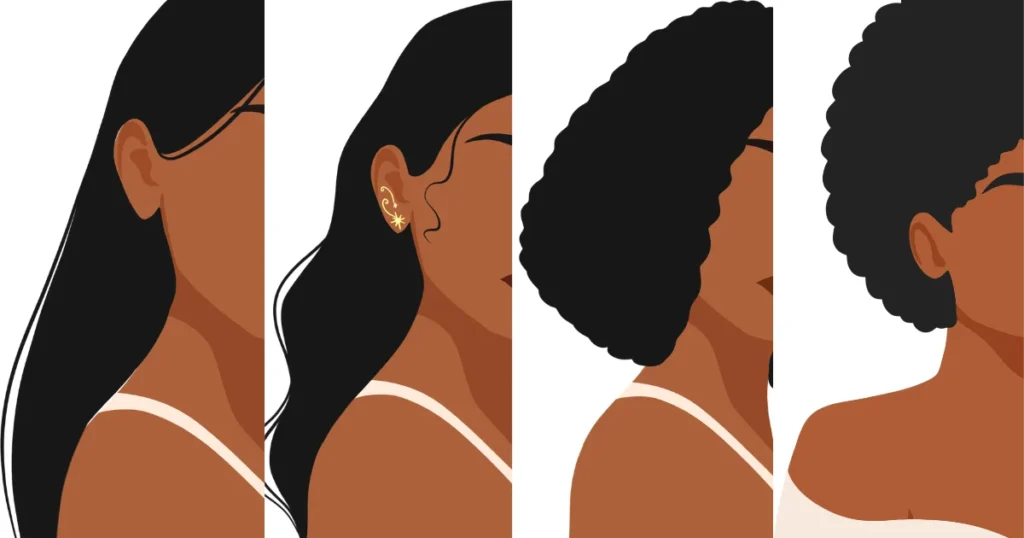
Tried countless hair care tips only to feel let down? The secret to healthier, more beautiful hair starts with understanding your unique hair type and what it truly needs. If you are not quite sure where to begin, these simple tips will help you identify your hair type and care for it with confidence.
Just like knowing your skin type is essential for effective skincare, understanding your hair type is the foundation of a successful hair care routine. Once you identify key factors such as texture, density, porosity, elasticity, and curl pattern, you can make more informed choices about the products, techniques, and habits that best support your hair’s health and natural beauty.
Unlocking Your Natural Hair Pattern and Texture
Your hair’s natural pattern, texture, and shape are as unique as you are. Understanding your hair type is important because it helps you choose the right care and styling techniques for your specific needs. The best part is that figuring out your hair type is not complicated; you don’t need to be a cosmetologist to do it.
Hair types are generally classified into four main categories: straight, wavy, curly, and coily. Within each category, there are distinct variations in texture and curl pattern that contribute to the uniqueness of each individual’s hair.
To begin identifying your hair type, examine your hair while it is damp and free of styling products. Gently run your fingers through it and observe its natural formation. Does it remain straight, develop soft waves, or form defined spirals? This simple observation can provide valuable insight into your hair’s natural characteristics.
Hair Typing System and Curl Patterns
You’ve probably heard of the Andre Walker Hair Typing System. Walker’s system breaks hair down into four primary categories:
Type 1 (Straight)
Type 2 (Wavy)
Type 3 (Curly)
Type 4 (Coily)
Remember, it’s perfectly fine if you have a mix of types. Many of us do.
Type 1 – Straight Hair: If your hair is sleek and straight, it’s all about simplicity.
Type 2 – Wavy Hair: Wavy hair with gentle S-shaped waves may have a touch of frizz.
Type 3 – Curly Hair: Curly hair forms distinct curls, ranging from loose to tight.
Type 4 – Coily Hair: Coily hair is the queen of texture with a natural zigzag pattern, often referred to as “kinky” or “afro-textured.”
Discovering Your Hair Type
Understanding Hair Texture
Hair texture refers to the natural shape and pattern of your hair strands and remains an essential factor when identifying your hair type. It can range widely, from fine and delicate to coarse and thick.
A simple way to assess your hair’s thickness is by using a common household item: standard sewing thread, about 6 to 8 inches long. Be sure to use regular sewing thread rather than a thicker thread meant for heavy-duty fabrics. For the most accurate results, your hair should be clean, dry, and free of styling products.
Take a strand of hair from the crown of your head and place it beside the thread on a white sheet of paper. This makes it easier to compare the strand’s thickness, colour, and overall texture.
Deciphering Your Hair Texture
Here’s how to interpret the results for different hair textures:
Type 1
Fine Straight Hair (Type 1a): Silky and soft, this hair type often lacks volume. Use lightweight, volumizing products, and consider a layered haircut to add body and bounce.
Medium Straight Hair (Type 1b): Versatile and balanced, this hair type works well with a variety of styles and products. Choose moderate formulas that provide moisture and nourishment without weighing the hair down.
Coarse Straight Hair (Type 1c): Thicker and often more resistant to styling, this hair type benefits from smoothing products and a quality hair straightener. Deep-conditioning treatments can also help manage its natural thickness.
Type 2
Fine Wavy Hair (Type 2a): Soft and delicate, this hair type is often prone to frizz. Choose lightweight, moisture-rich products, and use curl-enhancing formulas to define those gentle S-shaped waves.
Medium Wavy Hair (Type 2b): This hair type strikes a balance between straight and curly. Use hydrating shampoos and conditioners to maintain its natural movement, and consider a layered haircut to add shape and dimension.
Coarse Wavy Hair (Type 2c): Thicker with more defined waves, this hair type benefits from anti-frizz serums and creams that help smooth the hair while boosting shine.
Type 3
Fine Curly Hair (Type 3a): Soft and lightweight, this hair type can sometimes lack volume and definition. Deep-conditioning treatments and lightweight curl-enhancing products can help create bouncy, well-defined curls.
Medium Curly Hair (Type 3b): Offering a balance of volume and definition, this hair type benefits from moisturizing shampoos, nourishing conditioners, and medium-hold styling products to keep ringlets soft, shaped, and manageable.
Coarse Curly Hair (Type 3c): Thick and full with clearly defined curls, this hair type thrives on moisture. Deep conditioning and leave-in conditioners help maintain its shape, softness, and shine.
Type 4
Fine Coily Hair (Type 4a): Delicate and more prone to breakage, this hair type needs plenty of moisture and gentle handling. Use sulphate-free shampoos, deep-condition regularly, and limit heat styling to protect its health.
Medium Coily Hair (Type 4b): Thicker and more resilient, this hair type depends on consistent hydration. Protective styles such as braids and twists can help maintain healthy, beautiful hair while reducing daily manipulation.
Coarse Coily Hair (Type 4c): The thickest of the coily hair types, this texture features very tight coils or zig-zag patterns. It requires intense hydration and regular deep-conditioning treatments, along with nourishing natural oils like coconut or shea butter, to maintain softness, shape, and shine.
Hair Density: Understanding Your Hair’s Volume
Hair density refers to the number of individual strands growing on your scalp per square inch. It plays a major role in how full or thick your hair appears.
Figuring out your hair density is simple. Start by parting your hair down the middle and observing how much of your scalp is visible.
- If your scalp is clearly visible, you likely have low-density hair.
- If your scalp is somewhat visible, you likely have medium-density hair.
- If your scalp is barely visible, you likely have high-density hair.
Understanding your hair density can help you choose the right products, styles, and care routine to suit your hair’s natural volume.
The Connection Between Hair Density and Texture
Hair density and hair texture are closely related, but they are not the same. Density refers to how many strands of hair you have on your scalp, while texture describes the thickness of each strand. Understanding both can help you choose the best products, styles, and care techniques for your hair.
- Low Density with Fine Hair: This combination often appears thinner and may lack volume. Lightweight volumizing products and layered hairstyles can help create the look of fuller, more dynamic hair.
- High Density with Coarse Hair: This hair type looks full and rich, but it can also be more prone to frizz and heaviness. Moisture-rich products and leave-in conditioners can help improve softness, control frizz, and make the hair easier to manage.
- Medium Density with Medium Texture: This balanced combination is usually versatile and easy to style. It works well with a wide range of looks, from sleek straight styles to waves and curls, as long as the hair stays properly moisturized and cared for.
By understanding the relationship between density and texture, you can build a hair care routine that better supports your hair’s natural qualities.
Hair Porosity: Your Hair’s Moisture Retention Capacity
Hair porosity refers to your hair’s ability to absorb and retain moisture and products. It plays an important role in how your hair responds to washing, conditioning, and styling, making it a key factor when choosing the right hair care routine.
Testing your hair’s porosity is simple. Place a clean strand in a glass of water and observe what happens.
- If the strand floats, it usually indicates low porosity.
- If it sinks slowly, it suggests medium-to-normal porosity.
- If it sinks quickly, it typically means high porosity.
Once you understand your hair’s porosity, you can better tailor your routine to meet its needs:
- Low Porosity: Hair with low porosity has a tightly closed cuticle, which makes it harder for moisture to enter. Lightweight products and gentle heat during deep conditioning can help improve absorption.
- Medium Porosity: This hair type usually absorbs and retains moisture well. It tends to be easier to manage and responds well to a balanced routine of cleansing, conditioning, and regular maintenance.
- High Porosity: Hair with high porosity absorbs moisture quickly but also loses it just as fast. It often benefits from richer products, leave-in conditioners, and sealing oils to help lock in hydration.
Understanding your hair’s porosity can make a big difference in keeping it healthy, hydrated, and easier to manage.
Understanding Your Hair’s Natural Oil Production
Understanding Your Hair’s Natural Oil Production
Knowing your hair’s natural oil level is important for building the right hair care routine. The amount of oil your scalp produces is controlled by sebaceous glands and influenced by factors like hair care products, washing habits, and chemical treatments.
This natural oil production helps determine whether your hair falls into one of four categories: dry, normal, oily, or combination.
How to Determine Your Hair’s Oil Level
- Wash your hair and let it air dry completely.
- Avoid applying any styling or hair care products.
- Wait 8 to 12 hours.
- Gently press a tissue against your scalp, especially at the crown and behind your ears.
How to Read the Results
- If the tissue shows a noticeable amount of oil, your hair is likely oily.
- If there is only a slight trace of oil, your hair is likely normal.
- If there is no oil on the tissue, your hair is likely dry.
- If some areas show more oil than others, you likely have combination hair.
Understanding your scalp’s natural oil production helps you choose products and routines that keep your hair balanced, healthy, and easier to manage. Understanding Hair Health.
Hair elasticity refers to your hair’s ability to stretch and return to its original shape without breaking. It is an important indicator of overall hair health, strength, and resilience.
Hair with good elasticity is generally stronger and less likely to break, while hair with low elasticity is often more fragile and prone to damage.
How to Test Hair Elasticity
- Take a strand of freshly washed, towel-dried hair.
- Gently stretch it between your fingers.
- Observe how far it stretches before returning to its original length or breaking.
How to Read the Results
- If the strand stretches well and returns to its original shape, your hair has high elasticity and is generally healthy and strong.
- If it stretches a little before breaking, your hair has medium elasticity and may need added moisture and care.
- If it breaks almost immediately, your hair has low elasticity and may be more vulnerable to dryness, breakage, and damage.
Understanding your hair’s elasticity can help you identify its condition and choose the right treatments to keep it strong, healthy, and manageable.
In Conclusion
Your hair is a beautiful part of what makes you unique, and understanding its needs is the first step toward keeping it healthy and thriving. No matter your age, texture, or hair type, the right care routine can help enhance your natural beauty and strength.
We hope this guide has given you a clearer understanding of how to identify your hair type and care for it with confidence. From texture and density to porosity, oil production, and elasticity, each factor plays an important role in creating a routine that works best for you.
Embrace your hair for all that it is, care for it with intention, and remember that healthy hair begins with understanding and consistency. If you have questions or would like to learn more, we’re always here to help. If you experience persistent scalp issues, drastic changes in your hair’s texture, or challenges that do not improve with your current routine, consider consulting a professional hairstylist or dermatologist. Seeking expert advice can provide tailored solutions and ensure your hair remains healthy and beautiful.